If you’ve ever stood in the coffee section of a specialty shop, staring at a wall of espresso machines and wondering why some cost $500 and others $5,000, you’re not alone. When I started supplying semi-automatic espresso machines a few years back, I got so many questions from cafe owners, home baristas, and even seasoned coffee pros about the difference between semi-auto and fully automatic models. A lot of people think “automatic just means easier” — and yeah, that’s part of it — but there’s way more to it than just pressing a button. Today, let’s break this down like we’re chatting over a latte, no stuffy jargon, and throw in why semi-automatic machines are still the workhorses most coffee operations actually need. Semi Automatic Espresso Machine
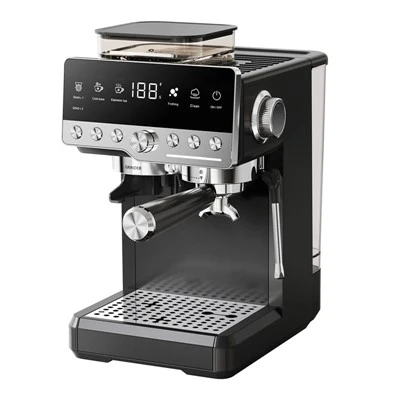
First, let’s get the basics out of the way, with a quick heads-up: I’m not here to bash fully automatic machines — they’ve got their place, especially for busy drive-thrus or offices where consistency is king over customization. But if you’re running a specialty cafe, a roastery tasting room, or even a home setup where you care about the taste of your espresso, semi-auto is where the magic happens.
Let’s start with what actually makes a machine semi-automatic vs. fully automatic, because that’s where all the confusion lives. A semi-automatic machine, at its core, lets you control two big things: how much water flows through the espresso grounds, and when that flow stops. You grind your own beans (or dose pre-ground, but we’ll get to that), tamp them into a firm puck, lock the portafilter into the group head, and then you manually press a button or flip a switch to start the water flow — and you manually stop it when you see the pour looks right (usually 25-30ml of liquid in 25-30 seconds, for reference). That’s it. No pre-programmed shot volumes, no auto-pause, no machine deciding when your pull is done.
A fully automatic machine? Well, it does almost all of that for you. Most of them grind the beans, dose them into the portafilter, tamp, lock, and then automatically pull a pre-programmed shot — stop at a set volume, even switch between espresso and milk for lattes or cappuccinos with one button. Some high-end fully automatic models let you tweak a few settings, but the basic function is the machine is pulling the shot for you, end to end.
Now, let’s talk about the stuff that actually matters to people who make a living with espresso, or take it seriously at home: control over the shot, learning curve, maintenance, cost, and customization.
Control is the big one. Espresso is a super finicky drink. Even a 2-second difference in pull time, or 5ml extra water, can turn a bright, fruity shot into a bitter, over-extracted mess. With a semi-automatic, you’re in the driver’s seat. Want to adjust the grind size to pull a longer shot for a creamier latte base? You can. Want to stop a pull halfway because it’s already tasting too sour (under-extracted)? You can hit the stop button immediately, no waiting for a machine’s pre-set time. That kind of control is gold for specialty coffee. When I supply semi-automatic machines, I tell new cafe owners that this is how you develop a signature shot. You tweak, test, adjust, and get exactly what you want — not what a machine is programmed to give you. Fully automatic machines lock you into a set pull, so if your beans change or your grinder gets off, you’re stuck with whatever the machine spits out until you reprogram it. Which, let’s be real, most baristas won’t bother doing regularly.
Next up, learning curve. I know what you’re thinking: “Control sounds great, but is semi-automatic hard to learn?” It’s not rocket science, but it does take a little practice. A new barista can learn to pull a consistent semi-automatic shot in a week or two, whereas a fully automatic lets someone who’s never touched espresso before pull a drink in 5 minutes. But here’s the catch: that “quick” skill with a fully automatic only gets you so far. Once the machine is calibrated, all drinks taste the same, even if the beans go stale or the grind gets uneven. With a semi-automatic, baristas develop a feel for the shot — they can tell if the grind is off by watching the pour, adjusting on the fly, which makes for way better, more dynamic drinks. For home baristas, too: if you want to level up your coffee game, semi-automatic teaches you the basics of espresso extraction, so you’re not just relying on a machine to do all the work.
Then there’s maintenance. This is a huge one I don’t see talked about enough. Semi-automatic machines are way simpler inside. Most models have fewer moving parts — no auto-grinders, no automated dosing systems, no fancy valves that control shot volume. That means fewer things can break. When I supply semi-automatic machines, my customers tell me they spend way less on repairs than fully automatic owners. Fully automatic machines have all those extra parts: grinders that get clogged with old coffee, solenoids that control shot flow, dosing mechanisms that can malfunction if not cleaned daily. For a busy cafe, downtime is money. If a semi-auto breaks, a tech can fix it in 15 minutes usually, and parts are cheap. If a fully automatic’s grinder dies, you’re looking at hundreds in repairs and days without a serviceable machine.
Cost is another big factor, split into upfront and ongoing. Upfront, a basic semi-automatic starts around $1,000, while a basic fully automatic is around $2,000. But mid-range semi-autos (the kind most small cafes use) are $2,000-$5,000, which is still cheaper than a comparable fully automatic with similar steam power for milk. Then, ongoing: semi-automatic machines use less energy? No, wait, actually it’s more about consumables: you don’t have to replace automatic-only grinder burrs, or parts for dosing systems. Also, if you’re a roaster or cafe that works with different bean suppliers, semi-autos let you adjust shots to match each roast — fully automatics rarely have that flexibility.
Wait, but let’s not gloss over the downsides of semi-automatic, because it’s not for everyone. If you’re a office with 50 people coming in every day, needing a latte fast, a semi-automatic will make a barista bottleneck. If you’re a coffee shop that does 1,000 drinks a hour, the semi-auto’s manual pulls will be slower than a fully automatic’s programmed shots. And if you don’t care about the nuance of espresso, just want a consistent cup every time, a fully automatic is fine. The point is, it’s all about what you need.
Let’s throw in a quick real example: last year I supplied a small specialty cafe in Portland, OR, that switched from a fully automatic to our semi-automatic machines. They told me their regulars noticed immediately — the shots were more balanced, they could pull different profiles for single-origin vs. blended beans, and their repeat business went up 18% because people could taste the difference. They did have to train their staff a little, but the payoff was worth it. Another customer, a busy hotel lobby, stuck with fully automatic because they needed to serve 200 drinks an hour quickly, and the consistency was more important than customization for their guests.
A common myth I hear all the time: “Fully automatic is more efficient because you can pull more shots an hour.” That’s only true if all shots are the same. If you have to adjust shots for different beans, or fix a bad pull, semi-automatic is actually faster in the long run. A good barista on a semi-auto can pull 12-15 shots an hour, same as a fully automatic, because they’re not fumbling with programming.
Another myth: “Semi-automatic is only for pros.” Nope, home baristas love them too. I have a lot of regular customers who bought semi-autos for their kitchen, because they want to get into specialty coffee, not just drink instant or pre-ground pods. It’s a skill that’s fun to learn, and you end up with a way better cup.
Now, if you’re someone who’s thinking about buying an espresso machine — whether for a cafe, a roastery, or your home — here’s what I’d tell you to ask yourself first: Do I want to control the taste of my shots, or just get a consistent drink? Do I have space and time for a little maintenance and training, or do I need something that runs on autopilot? Do I work with different beans or roasts, or is every drink the same?
If you answered “control over taste, have time for training, work with different beans” — semi-automatic is probably the right call. That’s why when I supply semi-automatic machines, I prioritize models that are reliable, easy to use, and give baristas all the control they need without the bloat of unnecessary parts.
I should also mention: yes, there’s also super-automatic machines, but those are a subset of fully automatic, even more automated. We’re not getting into those today, because for most people, the line is semi vs. fully.
So, to wrap this up: the core difference is control. Semi-automatic puts you (or your barista) in charge of when the shot starts and stops, letting you adjust on the fly for the best possible taste. Fully automatic takes that control away, programming the machine to do all the work, for speed and ease at the cost of customization. Both have their place, but if nuanced, great espresso is your priority, semi-automatic is the way to go.

If you’re in the market for a semi-automatic espresso machine — whether you’re opening a cafe, upgrading your setup, or restocking a roastery — feel free to reach out to discuss your needs and find the right machine for you.
Semi Automatic Espresso Machine References:
- Specialty Coffee Association (SCA) Espresso Extraction Guidelines, 2022
- Coffee Equipment Association (CEA) Commercial Espresso Machine Maintenance Report, 2023
- Home Barista Association, "Semi-Automatic vs. Fully Automatic: A User’s Guide", 2024
- National Restaurant Association, Commercial Kitchen Equipment Efficiency Study, 2023
Foshan City Moccona Electric Co., Ltd.
With abundant experience, we are one of the leading manufacturers and suppliers of semi automatic espresso machine in China. We warmly welcome you to buy bulk durable semi automatic espresso machine from our factory. If you have any enquiry about cooperation, please feel free to email us.
Address: Room 202, Building 16, Tongde Intelligent Manufacturing Park (TDIMP), No.9 Guizhou Avenue East, Shangjia Community, Ronggui Street, Shunde District, Foshan City, Guangdong Province
E-mail: tim@mocconaelectric.com
WebSite: https://www.mocconaelec.com/
